
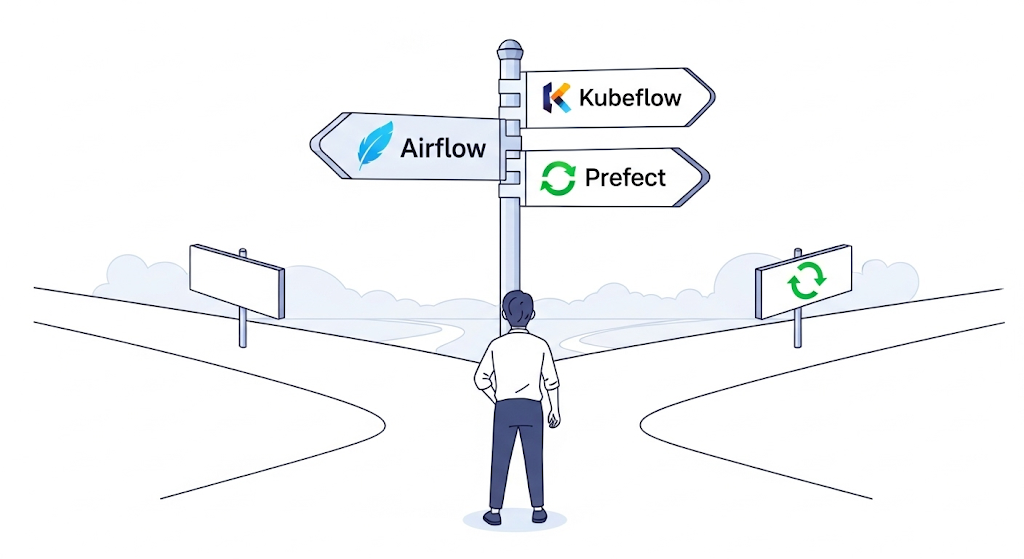
Choosing Your Orchestrator: A Startup’s Guide to Airflow vs. Kubeflow Pipelines vs. Prefect
I. Introduction: Why Workflow Orchestration Matters 🧠
In the machine learning lifecycle, workflow orchestration plays a critical role—often behind the scenes but essential for success. From preprocessing raw data to deploying trained models, every step in an ML pipeline must be reproducible, trackable, and ideally automated. That’s where workflow orchestrators come in: they define dependencies, enforce execution order, and help maintain reliability across environments 🔄.
For startups, this challenge is even more pronounced. Small teams often juggle multiple responsibilities with limited engineering resources. Manual workflows—whether through scattered Jupyter notebooks or custom scripts—quickly become bottlenecks. These ad-hoc pipelines introduce risks, such as skipped steps, hidden bugs, and broken reproducibility. Worse, they’re hard to scale as your models or team grow 📉.
This is why choosing the right orchestration tool isn’t just a technical decision—it’s a strategic one 🧭. A good orchestrator brings order to experimentation, accelerates iteration, and enables your team to operate like a much larger organization.
💡 This article is part of our Ultimate Guide to Cost-Effective Open-Source MLOps in 2025, where we explore every layer of a lean, modular MLOps stack designed for startups and technical founders. Be sure to bookmark it—it’s your blueprint to scaling machine learning infrastructure without enterprise costs.
Whether you’re deciding between Apache Airflow, Kubeflow Pipelines, or Prefect, this guide will help you choose the best fit for your startup’s orchestration needs. We’ll explore real-world trade-offs and use cases, with links to cluster articles and external tools that support smarter, faster deployment 🚀.
And if you’re ready to go beyond tutorials, we highly recommend the Prefect Cloud platform for teams who want an easy-to-use, production-grade orchestrator without managing infrastructure. It’s free to start and scales as your workflow complexity grows 🌐.
Let’s dive in.
II. What to Look for in a Workflow Orchestrator 🧩
When selecting a workflow orchestrator for your MLOps stack, especially in a lean and fast-moving startup, the key is striking a balance between power and simplicity. While enterprises may prioritize scale and feature completeness, startups need tools that support rapid experimentation, easy integration, and minimal operational overhead. The right choice can unlock velocity—while the wrong one can stall your entire pipeline ⚖️.
Here are the most important factors to consider when evaluating workflow orchestrators:
🧪 Dynamic vs. Static Pipelines
Dynamic pipelines, such as those enabled by Prefect, allow workflows to be written in Python code, making them flexible, testable, and easy to debug during development. In contrast, static DAGs (Directed Acyclic Graphs), such as those in Apache Airflow or Kubeflow Pipelines, are more rigid but well-suited for predictable, repeatable tasks, such as scheduled data ingestion or batch inference.
For ML use cases where the number of steps or dependencies might change at runtime (e.g., hyperparameter tuning), dynamic pipelines often offer a better developer experience and fewer headaches 💡.
🔄 Reproducibility & Scheduling
A core promise of MLOps is reproducibility—being able to rerun the same workflow and get consistent results. A good orchestrator should support state tracking, logging, and retries. Scheduling is another critical feature: does the tool support cron-like intervals, event-driven triggers, or manual restarts?
For instance, Airflow is renowned for its cron-native scheduling and retry mechanisms, making it a strong candidate for traditional ETL workflows. Prefect, on the other hand, supports event-based orchestration, enabling more responsive workflows (e.g., triggering training jobs on new data arrival) 🔁.
🔧 Deployment Ease
Startups rarely have the luxury of a dedicated DevOps team. So, deployment flexibility matters. Can the orchestrator run on your laptop, Docker, Kubernetes, or a fully managed cloud?
- Prefect Cloud offers a low-ops, hosted control plane that lets you deploy locally while monitoring in the cloud 🌤️.
- Airflow requires more setup but is available as Amazon MWAA for managed deployment.
- Kubeflow Pipelines, although powerful, assume you’re already embedded in a Kubernetes-first environment, which may be overkill for small teams 🐳.
🧰 Language-Native vs YAML-Heavy
Python-native orchestrators, such as Prefect or Metaflow, enable engineers to define workflows in code they already understand, thereby reducing onboarding time and minimizing context switching between Python and YAML.
YAML-based configurations, while declarative and readable, can become tedious and prone to errors in larger workflows. Tools like Kubeflow Pipelines often require the use of a DSL (domain-specific language) or SDK layered over YAML, which adds to the cognitive load for new users.
If your team values developer experience, Python-native orchestration is the most approachable and scalable route 🎯.
✅ Pro Tip: If you’re just getting started, check out the Prefect 2.0 Quick Start Guide to launch a dynamic Python workflow in minutes. For deeper scheduling control in enterprise-grade setups, explore Airflow’s DAG design docs.
By aligning your orchestrator with your team’s technical comfort level, deployment constraints, and workflow complexity, you can unlock speed and scalability from day one. Up next: a breakdown of the top tools worth your attention 👇.
III. Tool 1: Apache Airflow 🌬️
Apache Airflow is one of the most well-known and widely adopted open-source workflow orchestrators. Developed at Airbnb and now part of the Apache Software Foundation, it has become the industry standard for cron-based data engineering pipelines and time-triggered ML workflows ⏰. At its core, Airflow allows users to define Directed Acyclic Graphs (DAGs) using Python, representing tasks and their dependencies in a declarative manner.
Airflow’s architecture consists of a scheduler, executor, metadata database, and a web UI. The scheduler triggers tasks based on time or external events, while the executor handles task execution (e.g., via Celery, Kubernetes, or a Local Process). Its modular architecture makes it highly extensible and suitable for production environments where uptime and robustness are critical 🧱.
✅ Pros: Why Startups Still Choose Airflow
- Established ecosystem: With years of maturity and a large user base, Airflow benefits from a rich ecosystem of community-contributed operators (e.g., for AWS, GCP, Spark, Docker, and more).
- Battle-tested at scale: Airflow is used in production by companies like Airbnb, Stripe, and Shopify. Its reliability makes it a default choice for enterprises and data-heavy organizations.
- Cron-native: Airflow excels at scheduling recurring workflows, such as nightly batch jobs, regular data ingestion pipelines, and time-triggered retraining processes 🔁.
❌ Cons: What Might Hold You Back
- Steep learning curve: Airflow’s setup, configuration, and DAG authoring can be intimidating for newcomers, especially in lean teams without a DevOps engineer 😓.
- Verbose and rigid: DAGs in Airflow are defined using Python, but they often feel more like static configuration than dynamic code. Complex branching logic or dynamic task generation can be cumbersome.
For small ML teams focused on rapid prototyping and iteration, Airflow might feel too heavyweight unless you’re already operating in a traditional ETL or enterprise analytics context.
🧠 Best Use Cases
Airflow shines when managing time-based or batch pipelines—think nightly retraining jobs, periodic data aggregation, or predictable reporting workflows. It’s also a good fit if your team already uses SQL-based transformations, Spark jobs, or needs tight integration with enterprise schedulers like Apache Hive or Hadoop.
🛠️ Recommended Learning Resource
Want to master Airflow from the ground up? We highly recommend the Ultimate Hands-On Apache Airflow course on Udemy. This comprehensive resource guides you through DAG creation, task retries, sensors, and real-world examples—perfect for engineers and data scientists who are serious about orchestration 🧑💻📈.
🎓 Pro Tip: You can also try Amazon Managed Workflows for Apache Airflow (MWAA) for a production-grade deployment without maintaining the infrastructure yourself.
Next, we’ll examine Kubeflow Pipelines, a powerful alternative for ML-first teams operating on Kubernetes ☁️.
IV. Tool 2: Kubeflow Pipelines ☁️
Kubeflow Pipelines (KFP) is a specialized workflow orchestration tool built specifically for machine learning workloads on Kubernetes. It is part of the broader Kubeflow ecosystem, which provides a suite of components for building, training, deploying, and monitoring ML models at scale within containerized environments 🚀.
At its core, KFP enables teams to define ML pipelines as Python components or YAML configurations and run them as containerized steps within Kubernetes clusters. Each pipeline step is packaged in a Docker container, ensuring environmental isolation, repeatability, and scalability—critical for ML experimentation and production workflows.
✅ Pros: Where Kubeflow Pipelines Excels
- Tight Kubernetes integration: Kubeflow Pipelines is purpose-built for K8s-native environments, giving complete control over resource allocation, autoscaling, and advanced scheduling.
- Visual pipeline interface: With its built-in UI, users can track pipeline runs, visualize DAGs, monitor step outputs, and debug errors more intuitively than with traditional log-based systems 🎛️.
- Built-in experiment tracking: KFP offers built-in support for tracking runs, comparing metrics, and managing versions—making it valuable for experimentation-heavy ML workflows 🔬.
❌ Cons: What Might Hold You Back
- Heavy deployment footprint: Setting up Kubeflow and its dependencies—such as Istio, Argo, and Kubernetes RBAC—requires substantial operational knowledge, even before defining your first pipeline 🧱.
- Overhead for small teams: If you’re a lean team or early-stage startup, maintaining a full Kubeflow stack may be overkill and time-consuming, especially if your use cases don’t yet demand large-scale training clusters or GPU orchestration 😓.
Unless your team is already operating in a Kubernetes-first environment (e.g., GKE, EKS), Kubeflow’s operational complexity could slow down iteration rather than accelerate it.
💡 Ideal Use Cases
Kubeflow Pipelines is a natural choice for platform teams, MLOps engineers, or larger data science teams working with multiple environments (e.g., training, staging, production). It’s particularly powerful for managing A/B testing, hyperparameter tuning, and complex model lifecycle management workflows within cloud-native infrastructures.
🧭 Getting Started: KFP on Google Cloud
The easiest on-ramp to Kubeflow Pipelines is via Vertex AI Pipelines on Google Cloud, which provides a managed version of KFP with security, scalability, and integration built in. Google handles the infrastructure, so your team can focus on building ML pipelines—not managing Istio configs 🔐.
🛠️ Pro Tip: If you’re new to KFP but already use Kubernetes, check out this Quickstart guide from the official docs.
In the next section, we’ll pivot to a modern, Python-native alternative built for speed and developer friendliness—Prefect ⚡.
V. Tool 3: Prefect ⚡
Prefect is a modern, Python-native workflow orchestration framework designed with developer experience in mind. Unlike traditional orchestrators that can feel configuration-heavy, Prefect embraces a code-first philosophy—your workflows are just Python code, making them more dynamic, testable, and maintainable 🐍.
From data ingestion to model deployment, Prefect provides flexible task orchestration with built-in asynchronous execution, retry logic, and rich observability through its intuitive UI. The framework integrates smoothly with popular Python ML and data tools, making it an excellent choice for lean MLOps teams focused on fast iteration cycles and minimal overhead ⚙️.
✅ Pros: Why Teams Love Prefect
- Code-first workflows: Write orchestration logic directly in Python without verbose YAML—perfect for teams already living in the Python ecosystem 🧑💻.
- Easy onboarding: With Prefect Cloud, you can start orchestrating in minutes, without needing to provision your servers. It’s free for small teams and easily scales up as your workloads grow 💸.
- Built-in async & UI: Prefect supports asynchronous task execution out of the box, plus a clean web UI for monitoring, debugging, and replaying failed runs.
❌ Cons: Where Prefect Might Fall Short
- Smaller community: Compared to Apache Airflow’s massive ecosystem, Prefect’s user base and third-party integrations are still in their early stages of growth 🌱. While the gap is closing, niche connectors may need to build their custom tasks.
💡 Ideal Use Cases
Prefect is a sweet spot for Pythonic teams, early-stage startups, and ML engineers who need orchestration without the complexity of Kubernetes or heavyweight schedulers. It shines in short iteration loops, rapid experimentation, and projects where developer productivity is a higher priority than managing massive distributed workflows.
💸 Recommendation: Start with Prefect Cloud
For small and agile teams, Prefect Cloud is a game-changer—it offers free orchestration for up to 20,000 task runs/month, hosted infrastructure, and enterprise-grade features like role-based access control when you scale up. This lets you skip DevOps overhead while still enjoying full orchestration capabilities 🌐.
🧠 Pro Tip: Pair Prefect with DVC for data versioning and MLflow for experiment tracking, creating a lightweight but powerful MLOps stack. This combination is covered in detail in our Ultimate Guide to Cost-Effective Open-Source MLOps in 2025.
VI. Other Notables: Metaflow, Dagster & More 🧪
While Airflow, Kubeflow Pipelines, and Prefect dominate much of the MLOps orchestration conversation, there are several other powerful tools worth mentioning—especially if your workflow has specific constraints or advanced requirements 🎯.
Metaflow 🌀
Originally developed at Netflix, Metaflow was designed to make it easier for data scientists to build, manage, and scale ML workflows without being bogged down by infrastructure details. It excels at model versioning, data lineage tracking, and human-readable pipeline definitions.
- Pros: Great integration with AWS, built-in version control for both data and models, Pythonic syntax 🐍.
- Cons: Best suited for teams already invested in AWS; less community adoption outside of enterprise setups.
📚 Recommended: Explore the free Full Stack Deep Learning Metaflow Tutorial to see it in action.
Dagster 🏗️
Dagster is a functional, type-safe orchestrator that shines in structured, schema-aware data pipelines. It enforces type checks and data contracts, reducing runtime errors and improving reproducibility ✅.
- Pros: Strong developer tooling, ideal for analytics and ML hybrid workflows, and a rich local development experience.
- Cons: More opinionated than Prefect, steeper learning curve for beginners.
🧠 Pro Tip: Dagster pairs well with dbt for analytics engineering—ideal if your ML workflow also includes heavy SQL transformation steps.
Flyte 🚀
Born at Lyft, Flyte is purpose-built for scaling deep learning workloads and managing multi-step, resource-intensive ML pipelines. It’s Kubernetes-native and supports dynamic task execution across GPU and CPU clusters.
- Pros: Excellent for distributed training, handles complex dependency graphs, and is battle-tested in production at scale.
- Cons: Requires Kubernetes expertise and has a heavier operational footprint compared to Prefect or Airflow.
💡 Getting Started: If you’re training large models, the official Flyte Getting Started Guide is a must-read.
Bottom line: If your needs are cloud-specific (Metaflow), type-safe and analytics-heavy (Dagster), or focused on deep learning (Flyte), these orchestrators may be a better fit than the “big three.” For lean startups, however, sticking to Prefect or Airflow may help keep complexity and operational overhead lower.
VII. Decision Matrix: What to Choose Based on Your Context 🎯
Choosing the right workflow orchestrator isn’t about picking the “most popular” tool—it’s about aligning your team’s skills, infrastructure, and workflow complexity with the tool’s strengths 🧩. Below is a practical decision matrix to help you match use cases with the right orchestrator, ensuring you avoid both under-engineering and over-engineering your MLOps stack.
| Use Case | Recommended Tool | Why It Fits |
| Lightweight + Pythonic 🐍 | Prefect | Ideal for lean teams that want to orchestrate directly in Python without verbose YAML. Low operational overhead and great for rapid experimentation. |
| Legacy ETL / Batch Jobs ⏳ | Apache Airflow | Battle-tested for cron-based, time-triggered workflows. Strong ecosystem and widely adopted in data engineering. |
| Full K8s / Cloud-native ML ☁️ | Kubeflow Pipelines | Kubernetes-native, integrates seamlessly with GPU scheduling and distributed ML workloads. Best for cloud-first teams. |
| Versioning & Lineage-heavy 🧬 | Metaflow | Tracks every version of data and models with built-in lineage, perfect for auditability and reproducibility at scale. |
| Complex Data Dependencies 🏗️ | Dagster | Type-safe orchestration that enforces data contracts, great for analytics + ML hybrid pipelines. |
💡 Pro Tip: Don’t feel locked into a single tool. Some teams successfully combine Prefect for lightweight orchestration with DVC for data versioning or run Airflow for ETL while using Kubeflow for model training pipelines. The key is ensuring your stack stays cohesive and maintainable.
📥 Downloadable Resource: We’ve prepared a free PDF Decision Matrix and a Notion Template version so you can share it with your team, customize it, and track your final choice collaboratively.
VIII. Hybrid Patterns: Can You Mix & Match? 🔗
In the real world, no single orchestrator can cover every scenario perfectly—especially in startup environments, where flexibility is a competitive advantage 🚀. That’s why many engineering teams adopt hybrid orchestration patterns, combining the strengths of multiple tools into one cohesive pipeline. When executed correctly, this approach strikes a balance between speed, scalability, and maintainability.
1. Prefect Orchestrating MLflow Jobs 🐍📊
Prefect’s Python-native API makes it easy to call MLflow experiments as part of a larger pipeline. For example, you can run data preprocessing tasks in Prefect, trigger MLflow to handle experiment logging, and then return the results to Prefect for post-processing or deployment.
💡 This is especially powerful when combined with Prefect Cloud for orchestration and MLflow’s model registry for version control—ideal for lean MLOps setups.
2. Airflow Triggering Kubeflow Pipelines 🌬️☁️
For teams already using Apache Airflow for ETL and data engineering, it’s possible to integrate Kubeflow Pipelines as specialized tasks. Airflow handles upstream data movement, while Kubeflow runs GPU-intensive training workflows on Kubernetes. This division allows you to keep Airflow where it excels—scheduling and orchestration—while leveraging Kubeflow’s ML-specific scaling capabilities.
3. Using Metaflow with Prefect Agents 🧬⚡
Metaflow’s versioning and lineage tracking can be combined with Prefect’s agent-based deployment for better task distribution. This hybrid approach works well for teams that require full reproducibility of datasets and models (Metaflow) while maintaining lightweight and Pythonic orchestration (Prefect). It’s a pattern favored by AWS-centric ML teams who need tight integration with cloud storage.
4. GitHub Actions + Prefect for CI/CD 🛠️🔄
For CI/CD automation, GitHub Actions can handle code linting, testing, and Docker image builds, then trigger a Prefect deployment for running ML pipelines in production. This keeps your DevOps and MLOps workflows aligned, ensuring that every push to main can initiate a full retraining and deployment cycle without manual steps.
💡 Pro Tip: Hybrid orchestration works best when boundaries between tools are clear—avoid overlapping responsibilities to reduce complexity. Always define a “source of truth” for scheduling and state management to prevent race conditions or duplicated runs.
📥 Extra Resource: Download our Hybrid MLOps Orchestration Playbook for step-by-step diagrams and YAML templates for each pattern.
Baik, berikut adalah versi lengkap untuk IX. Tool Comparison Table 📊 sesuai permintaan Anda, dengan rekomendasi produk, sumber otoritatif, dan emoji yang relevan:
IX. Tool Comparison Table 📊
Choosing the right workflow orchestrator often comes down to the team’s skill set, infrastructure, and the speed of onboarding. The table below summarizes the key differences between three of the most popular options—Apache Airflow, Kubeflow Pipelines, and Prefect—so you can make a decision in minutes instead of weeks.
| Feature | 🌬️ Airflow | ☁️ Kubeflow | ⚡ Prefect |
| Language | Python + YAML | Python / YAML / Kubeflow SDK | Python-native |
| Hosting | Self-host / AWS MWAA | Self-host / GCP Vertex AI Pipelines | Cloud or self-host |
| UI / Monitoring | Basic, minimal | Visual DAGs | Clean UI, async-friendly |
| Setup Time ⏳ | High | Very High | Low |
| Ideal For | ETL, batch processing | K8s-first ML teams | Startups, solo devs |
💡 Recommendation:
- If you’re running traditional ETL or time-based ML jobs, Airflow remains the safest bet. Consider MWAA for reduced ops burden.
- For Kubernetes-native ML workloads with heavy GPU usage, Kubeflow Pipelines shines—especially when paired with GCP Vertex AI for managed hosting.
- Startups and solo developers will find Prefect Cloud the fastest to implement, with free tiers that can scale later.
📥 Downloadable Resource: Get the MLOps Orchestrator Comparison PDF for an offline-friendly, shareable version of this table. Perfect for quick internal discussions or investor updates.
X. Final Verdict + Recommended Learning Path 🧭
When it comes to workflow orchestration for startups, there’s no one-size-fits-all answer—only the right fit for your current team size, tech stack, and scaling ambitions. For most early-stage teams, the best route is to start lightweight and iterate:
- ⚡ Start with Prefect Cloud — It’s fast to set up, Python-native, and comes with a free tier perfect for proof-of-concept pipelines. You can be running orchestrated MLflow or data preprocessing jobs in hours, not days.
- 🌬️ Graduate to Apache Airflow when your workflows grow in complexity or when you need tighter integration with existing ETL processes. Pairing it with AWS MWAA can significantly reduce operational headaches.
- ☁️ Adopt Kubeflow Pipelines once you’re running containerized, GPU-accelerated ML workloads at scale, especially in Kubernetes-first environments.
📌 Full MLOps Context:
This orchestration strategy is just one piece of the complete Ultimate Guide to Cost-Effective Open-Source MLOps in 2025—the article that walks you through every stage of the ML lifecycle, from data versioning to monitoring.
🎓 Recommended Learning Path:
To build real-world orchestration skills, start with a structured, hands-on course. One of the most practical options is “Build an ML Workflow with Airflow” on Coursera. This course guides you through:
- Designing DAGs for ML pipelines
- Scheduling and monitoring jobs
- Deploying Airflow on cloud infrastructure
For a Prefect-focused approach, check out the Prefect University—a free resource straight from the Prefect team.
💡 Pro Tip: Document your orchestration setup as early as possible. Using a shared Notion space or GitHub README with architecture diagrams will make onboarding new engineers far smoother and help maintain consistency across environments.
XI. Further Reading 📚
Learning workflow orchestration doesn’t stop here—mastery comes from exploring the official docs, hands-on experimentation, and connecting each tool to your broader MLOps pipeline. Here’s a curated list of authoritative resources and related deep dives to help you level up:
- ⚡ Prefect Documentation – The official guide to building Python-native workflows, deploying them locally or in the cloud, and managing tasks with Prefect’s modern orchestration engine. Ideal if you’re starting small but want to scale.
- 🌬️ Apache Airflow Documentation – Comprehensive coverage of DAG authoring, scheduling, and monitoring. A must-read before tackling enterprise-scale batch processing or complex ETL jobs.
- ☁️ Kubeflow Pipelines Documentation – Learn to design and manage ML pipelines in Kubernetes, with examples and deployment strategies for cloud-first teams.
📌 Connect to the Bigger Picture:
Workflow orchestration is just one part of the complete Ultimate Guide to Cost-Effective Open-Source MLOps in 2025—our article that integrates orchestration with data versioning, experiment tracking, model serving, monitoring, and CI/CD.
🤖 Dive into Related Clusters:
If you’re ready to automate the deployment of your models, read Automating the CI/CD Pipeline for ML. This cluster article covers CML and GitHub Actions, showing how orchestration integrates with continuous delivery pipelines for machine learning.💡 Pro Tip: Combine these documents with practical training, such as the “Build an ML Workflow with Airflow” Coursera course, which blends theory with project-based execution—ideal for engineers who want to build production-ready pipelines quickly.

Pingback: The Ultimate Guide to Building a Cost-Effective Open-Source MLOps Stack in 2025 - aivantage.space
Pingback: Building Your MLOps Career: Essential Open-Source Tools to Master for Interviews - aivantage.space